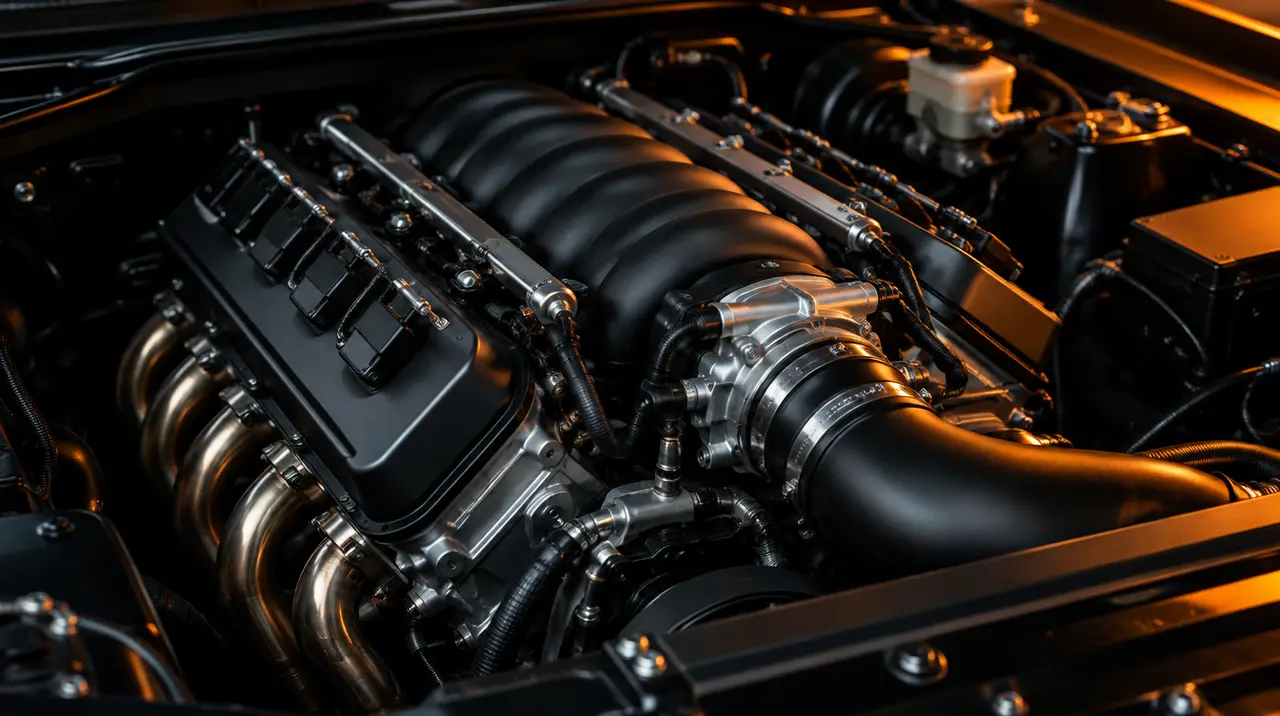
How a combustion engine works (in 60 seconds)
Almost all petrol and diesel engines are four-stroke piston engines. Inside each cylinder a piston moves up and down, repeating four steps:
- Intake — the piston moves down and sucks in air (and fuel, in some engines).
- Compression — the piston moves up and squeezes the mixture.
- Power — the mixture burns: a spark plug ignites it in a petrol engine, while in a diesel the heat of compression alone ignites it. The explosion pushes the piston down.
- Exhaust — the piston moves up again and pushes the burnt gases out.
The pistons turn a crankshaft, which converts up-and-down motion into rotation that eventually spins the wheels. More cylinders and bigger cylinders (a larger displacement, measured in litres or cc) generally mean more power — but also more fuel consumption.
Efficiency reality check: a petrol engine turns only about 25–35% of the fuel’s energy into motion (up to ~40% in the best hybrids); the rest becomes heat. An electric motor converts roughly 90% of its energy into motion. That is the main reason EVs are so cheap to run.
Naturally aspirated vs turbocharged
Naturally aspirated (NA, “atmospheric”)
The engine breathes air at normal atmospheric pressure — nothing forces extra air in. To get more power you need a bigger engine or higher revs.
Pros
- Simple and very reliable
- Instant, linear throttle response
- Cheaper to maintain
Cons
- Less power per litre
- Usually uses more fuel for the same power
Turbocharged
A turbocharger uses exhaust gases to spin a turbine that pushes (compresses) extra air into the engine. More air + more fuel = more power from a smaller engine. This is called downsizing.
Pros
- High power from a small engine
- Strong low-rev pulling power (torque)
- Better economy in official tests
Cons
- More complex, turbo can wear out
- Slight delay (“turbo lag”)
- Sensitive to oil quality
Supercharger — does the same job as a turbo, but is driven by a belt from the engine instead of exhaust gas. No lag, but it steals some power. Some cars use an electric compressor to eliminate turbo lag.
Petrol vs diesel
| Petrol (gasoline) | Diesel | |
|---|---|---|
| Ignition | Spark plug | Heat of compression |
| Character | Revs high, smooth and quiet | Strong pull at low revs, more clatter |
| Fuel consumption | Higher | 15–25% lower |
| Best for | City, short trips, low mileage | Motorway, high mileage, towing |
| Weak spots | — | DPF filter clogs on short trips, AdBlue system, expensive injectors |
| Future | Increasingly hybridised | Disappearing from small cars; banned from some city centres |
Beginner tip: if you mostly drive short trips in town (under 15–20 km), avoid a modern diesel. Its particulate filter (DPF) needs long drives to clean itself, and repairs are expensive.
Cylinder layouts: inline, V, boxer, W
How the cylinders are arranged affects the engine’s size, smoothness and sound:
Inline (straight) — I3, I4, I6
All cylinders in one row. The inline-4 is the most common engine in the world. The inline-6 is famously smooth (BMW, Toyota Supra). Three-cylinder engines are small and economical but vibrate a bit more.
V-engine — V6, V8, V10, V12
Two rows of cylinders in a “V” shape. Shorter than an inline engine with the same number of cylinders, so big engines fit. The V8 is the soundtrack of American muscle cars; V12s power Ferraris and Rolls-Royces.
Boxer (flat)
Cylinders lie flat, opposite each other, pistons moving like boxers’ fists. Low and well balanced, giving a low centre of gravity. Used by Subaru and Porsche (911, 718).
W-engine and rotary
A W engine joins two narrow V’s together — the Bugatti W16 has 16 cylinders. The rotary (Wankel) engine uses a spinning triangular rotor instead of pistons: tiny, light and high-revving but thirsty. Mazda made it famous in the RX-7 and RX-8.
Hybrids: engine + electric motor
A hybrid combines a combustion engine with one or more electric motors and a battery. The electric part recovers energy when you brake (regenerative braking) and helps the engine when accelerating, which saves fuel — especially in city traffic.
Mild hybrid
A small 48-volt starter-generator helps the engine and makes stop-start smoother. It cannot drive on electricity alone. Saves around 5–10% fuel.
Full hybrid (self-charging)
Can drive slowly on pure electricity for short distances, and switches automatically between engine and motor. No plug needed. Saves 20–40% fuel in town. Toyota and Lexus pioneered it with the Prius (1997).
Plug-in hybrid
A bigger battery charged from a socket provides 40–100 km of electric driving, with a petrol engine for longer trips. Very cheap to run if you charge it every day; if not, it is just a heavy petrol car.
Range extender
The wheels are always driven by an electric motor. A small petrol engine works only as an on-board generator when the battery runs low. Popular with Chinese brands (Li Auto, Leapmotor).
Series vs parallel: in a parallel hybrid both the engine and the motor can turn the wheels; in a series hybrid only the motor does, while the engine charges the battery (like Nissan e-Power). Most full hybrids are a clever mix of both (“power-split”).
Electric motors (BEV)
A battery electric vehicle has no engine, no gearbox with multiple gears, no oil changes and no exhaust. A large battery (usually 40–100 kWh) feeds one or more electric motors.
- Instant torque — full pulling power from zero rpm, so even family EVs accelerate briskly.
- Very few moving parts — lower maintenance costs; brakes last longer thanks to regeneration.
- Quiet and smooth — no vibration, no gear changes.
- Challenges: higher purchase price, charging time, range drops in cold weather (by 10–30%), and battery ageing.
Motor types you might see in specs: permanent-magnet synchronous motors (most common, very efficient) and induction motors (no rare-earth magnets, used by Tesla on some axles). Dual-motor EVs have one motor per axle and therefore all-wheel drive.
Battery chemistry matters too: LFP (lithium iron phosphate) batteries are cheaper, last longer and can be charged to 100% daily; NMC batteries store more energy for the same weight. Learn about charging in Fuel & energy.
Hydrogen fuel cells and other alternatives
- Hydrogen fuel cell (FCEV) — hydrogen from a tank reacts with oxygen in a fuel cell to make electricity; the only emission is water. Refuelling takes 5 minutes, but stations are very rare and hydrogen is expensive. Examples: Toyota Mirai, Hyundai Nexo.
- Hydrogen combustion engine — a modified piston engine that burns hydrogen. Being tested in racing and trucks.
- LPG / CNG engines — petrol engines converted (or built) to run on liquefied petroleum gas or compressed natural gas. Cheaper fuel, lower CO₂. See gas fuels.
- Flex-fuel — engines that run on any mix of petrol and ethanol (very popular in Brazil).
How to read engine specs
| Spec | What it means | Typical values |
|---|---|---|
| Displacement | Total volume of all cylinders | 1.0–2.0 L for most cars |
| Power (hp / kW) | How much work the engine does — top speed and acceleration | 100–200 hp for family cars; 1 kW ≈ 1.36 hp |
| Torque (Nm) | Twisting force — pulling power at low speed | 200–400 Nm |
| 0–100 km/h | Acceleration time | 8–11 s normal; under 5 s is very fast |
| Consumption | Fuel used per 100 km | 5–8 L/100 km; EV 14–20 kWh/100 km |
| CO₂ (g/km) | Emissions, often used for taxes | 100–180 g/km |
| Euro 6 / Euro 7 | European emission standard of the engine | Newer = cleaner |
Convert hp, kW and torque units with the tool in our glossary.
Which engine should a beginner choose?
Full hybrid
The safest all-round choice: low fuel use, very reliable, nothing to plug in.
Electric
Best if you can charge at home or work: cheapest to run and to maintain.
Small petrol
Cheapest to buy; ideal for low mileage and budget used cars. Naturally aspirated = simplest.