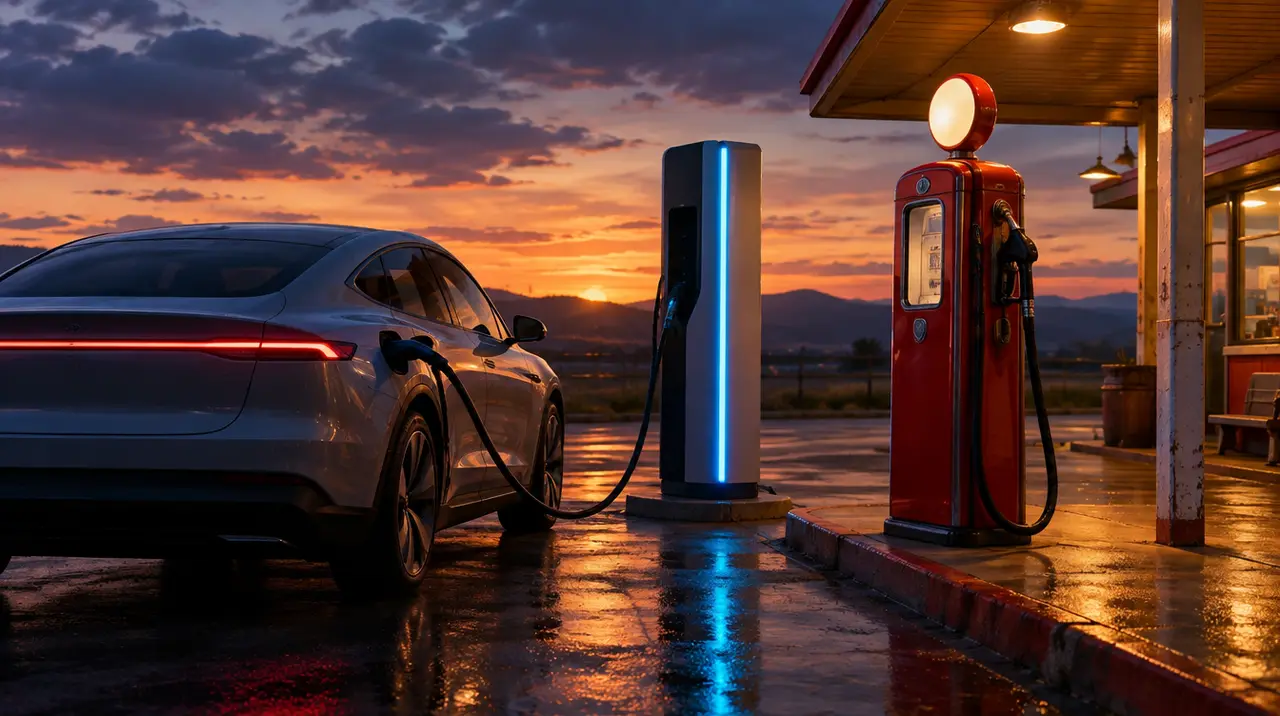
Overview of energy sources
| Energy | Used by | Refuelling | Availability | CO₂ at tailpipe |
|---|---|---|---|---|
| Petrol (gasoline) | Petrol engines, hybrids, PHEVs | ~5 min | Everywhere | Yes |
| Diesel | Diesel engines | ~5 min | Everywhere | Yes |
| LPG (autogas) | Converted petrol engines | ~5 min | Common in Europe, Turkey, Korea | ~10–15% less |
| CNG / biomethane | Gas-powered cars | ~5 min | Limited | ~20–25% less |
| Ethanol (E85) | Flex-fuel cars | ~5 min | Brazil, USA, Sweden, France | Lower overall |
| Electricity | EVs, PHEVs | 20 min – 10 h | Growing fast | None |
| Hydrogen | Fuel cell cars | ~5 min | Very rare | None (water only) |
Petrol: what do 92, 95 and 98 mean?
The number on the pump is the octane rating — how resistant the fuel is to “knocking” (burning too early under compression). It is not a measure of quality or energy content.
- Europe, Russia, most of the world use the RON scale: 92, 95 (standard), 98/100 (premium).
- USA and Canada show the average of RON and MON (AKI): 87 regular ≈ RON 91–92, 91–93 premium ≈ RON 95–98.
Golden rule: use the octane your manufacturer specifies (look inside the fuel filler flap or in the manual). Higher octane than required gives little or no benefit; lower octane than required can damage a turbocharged or high-compression engine.
E5 / E10 — the petrol contains 5% or 10% ethanol. Almost all cars built after 2011 can use E10; check compatibility for older and classic cars.
Diesel
Diesel contains more energy per litre than petrol, which is one reason diesel cars use less fuel. Things to know:
- Summer, winter and arctic diesel — in cold climates diesel can turn to gel. Winter grades work down to about −20 °C, arctic grades lower.
- AdBlue (DEF) — a urea solution that modern diesels inject into the exhaust to cut NOx emissions. You top it up every 5,000–20,000 km; if it runs out, the car will not start.
- HVO — renewable diesel made from waste oils; can be used in many modern diesel cars and cuts lifecycle CO₂ significantly.
Wrong fuel? Putting petrol into a diesel car (or vice versa) is a common mistake. Do not start the engine — call for help to drain the tank. Starting it can destroy the fuel pump and injectors.
Gas fuels: LPG and CNG
LPG (autogas, propane-butane)
Stored as a liquid in a tank (often in the spare-wheel well). Costs roughly half the price of petrol per litre in many countries, although consumption is ~15–20% higher. Cars usually keep their petrol tank too — double range. Factory LPG cars are sold by Dacia, Renault and others; aftermarket conversions are common.
CNG (compressed natural gas)
Methane stored at 200 bar in heavy cylinders. Very cheap per kilometre and cleaner, but stations are scarce in many regions. Popular in Italy, India, Pakistan, Argentina and Iran. Biomethane from waste is nearly CO₂-neutral.
Electricity: how EV charging works
EV energy is measured in kilowatt-hours (kWh) — like litres for fuel. A typical EV uses 14–20 kWh per 100 km. Charging speed is measured in kilowatts (kW).
| Charging type | Power | Adds per hour | 0–100% (60 kWh battery) | Where |
|---|---|---|---|---|
| Household socket (AC) | 2–3 kW | ~12–15 km | ~24 h | Emergency / overnight |
| Wallbox (AC) | 7–22 kW | ~40–110 km | 4–9 h | Home, work, car parks |
| DC fast charger | 50–150 kW | — | 10–80% in 30–45 min | Highways, cities |
| DC ultra-fast | 150–400+ kW | — | 10–80% in 15–25 min | Highway hubs |
Connectors
- Type 2 (Mennekes) — standard AC plug in Europe; CCS2 adds two DC pins for fast charging.
- NACS (Tesla) — becoming the standard in North America; CCS1 and J1772 are older US plugs.
- GB/T — the Chinese standard. CHAdeMO — older Japanese DC standard, now fading out.
EV tips for beginners: charge to 80% for daily use and to 100% only before long trips (LFP batteries are the exception — they are happy at 100%). Fast charging slows down after 80%, so it is quicker to stop twice for 20 minutes than once for an hour.
Hydrogen
Hydrogen cars refuel at 700 bar in about five minutes and emit only water vapour. The catch: there are only around a thousand public stations worldwide (mostly in Japan, Korea, China, Germany and California), and the price per kilometre is often higher than petrol. Unless you live next to a station, hydrogen is not a practical choice today.
Fuel economy converter
Europe and most of the world measure consumption in litres per 100 km (lower is better). The USA and UK use miles per gallon (higher is better), and many Asian and Latin American countries use km per litre. Type in any box:
L/100 km ⇄ MPG ⇄ km/L
US gallon = 3.785 L, UK (imperial) gallon = 4.546 L — that is why US and UK MPG differ.
Running-cost calculator: fuel vs electricity
Compare what you would spend on energy per year. Enter prices in your own currency.
Yearly energy cost
Energy only — insurance, tax, maintenance and depreciation are not included. Public fast charging can cost 2–3× more than home electricity.
10 ways to use less fuel
- Drive smoothly — hard acceleration and braking can raise consumption by 20–30%.
- Keep tyres at the correct pressure (check monthly).
- Slow down on the motorway: 110 km/h instead of 130 km/h saves around 15–20%.
- Remove roof boxes and racks when not in use.
- Don’t carry unnecessary weight in the boot.
- Use the highest sensible gear and shift early (around 2,000–2,500 rpm).
- Anticipate traffic and coast to red lights.
- Use air conditioning sensibly; at high speed it is still better than open windows.
- Keep up with servicing — clean filters and fresh oil matter.
- Combine short trips: a cold engine uses much more fuel.