Your 5-minute monthly check
Tyre pressure
Check when tyres are cold. The correct values are on a sticker inside the driver’s door or the fuel flap — not on the tyre itself (that is the maximum).
Engine oil level
Engine off, car on level ground: pull the dipstick, wipe it, reinsert, pull again. The level should be between MIN and MAX. Many new cars show it on the screen instead.
Fluids
Coolant, washer fluid and brake fluid levels are visible through translucent reservoirs under the bonnet.
Lights and wipers
Walk around the car with the lights on; replace streaky wiper blades (usually every 6–12 months).
Typical service intervals
| Item | Typical interval | Why it matters |
|---|---|---|
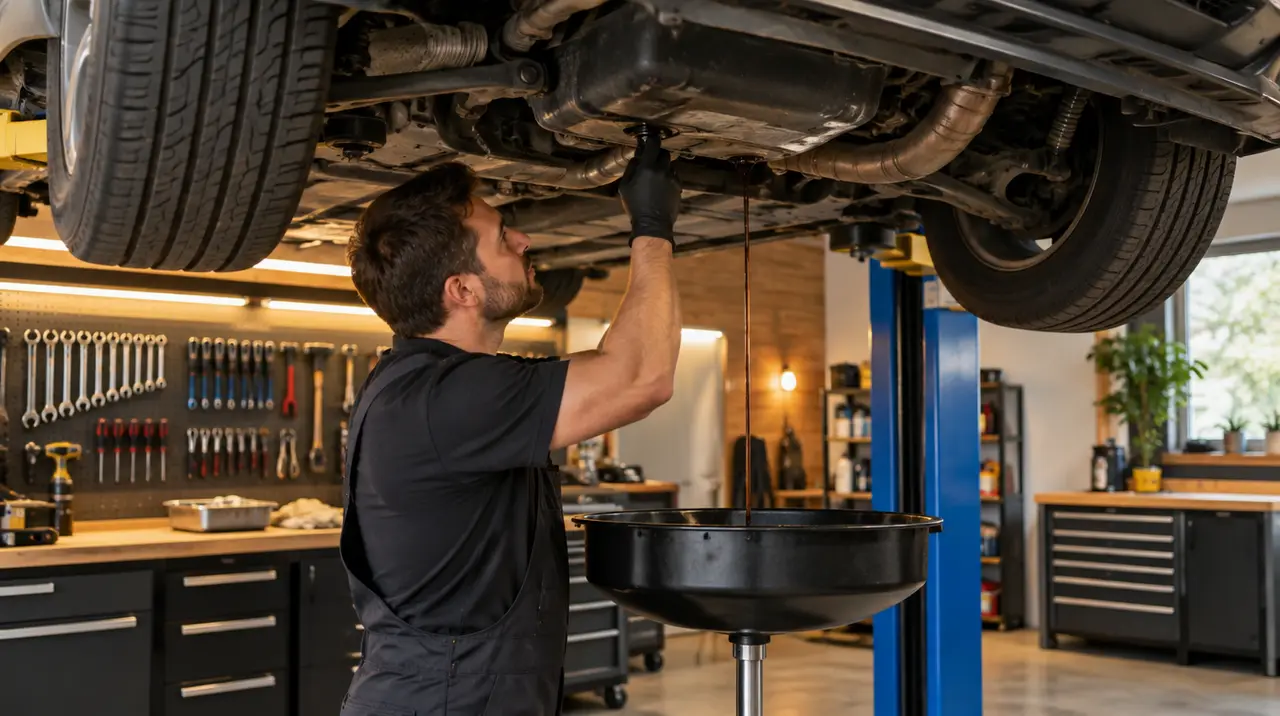
| Engine oil + filter | 10,000–15,000 km or once a year (more often for turbo engines, short trips, harsh climates) | Lubricates and cools the engine; old oil = accelerated wear |
| Air filter | 15,000–30,000 km | Clean air for the engine |
| Cabin (pollen) filter | Every year | Clean air for you; stops foggy windows |
| Brake fluid | Every 2 years | Absorbs water over time, reducing braking performance |
| Spark plugs | 30,000–100,000 km | Smooth running and economy (petrol engines) |
| Coolant | 4–5 years / as specified | Prevents overheating, freezing and corrosion |
| Timing belt | 60,000–150,000 km or 5–10 years | If it snaps, the engine can be destroyed — never skip it |
| Automatic gearbox oil | 60,000–100,000 km (even if “lifetime”) | Longer gearbox life |
| 12 V battery | Replace every 4–6 years | Starts the car and powers electronics |
Your owner’s manual wins. These are typical numbers. Always follow the schedule for your exact model — and keep all receipts: a full service history raises resale value.
Engine oil made simple
An oil label like 5W-30 describes its viscosity (thickness). The first number with “W” (winter) shows how well it flows when cold — lower is better for cold starts. The second number shows its thickness at operating temperature. Also check the approval required by your manufacturer (e.g. ACEA C3, API SP, VW 504.00, MB 229.5) — it is written in the manual.
Tyres: your only contact with the road
- Tread depth: the legal minimum is usually 1.6 mm, but wet-weather grip drops sharply below 3 mm (4 mm for winter tyres).
- Age: rubber hardens with time. Replace tyres older than 6–10 years even if they look fine. The DOT code shows the week and year: “2423” = 24th week of 2023.
- Reading the size: 205/55 R16 91V = 205 mm wide, sidewall 55% of width, radial, for 16-inch wheels, load index 91, speed rating V (240 km/h).
- Summer, winter, all-season: winter tyres use softer rubber and deep sipes that work below +7 °C. In snowy regions they are essential (and legally required in some countries).
- Rotation and alignment: rotate front and rear every 10,000 km; do an alignment if the car pulls to one side or tyres wear unevenly.
Brakes
Pads usually last 30,000–70,000 km, discs twice as long. Signs of wear: squealing or grinding, vibration in the pedal or steering wheel, a longer stopping distance, or the car pulling to one side. Hybrids and EVs use regenerative braking, so their pads can last well over 100,000 km — but discs can rust from lack of use, so brake firmly from time to time.
Dashboard warning lights
Colours tell you how urgent a light is: red = stop safely as soon as possible, amber/yellow = check soon, green/blue = information.
| Light | Colour | What to do |
|---|---|---|
| Oil pressure (oil can) | Red | Stop immediately and turn off the engine. Check oil level. Do not drive on. |
| Engine temperature (thermometer) | Red | Stop, let it cool. Never open a hot coolant cap. |
| Brake system (circle with “!”) | Red | Check the handbrake is off; if it stays on, brake fluid may be low — get help. |
| Battery / charging | Red | Alternator or belt problem; drive to a garage directly or stop. |
| Check engine (engine outline) | Amber | Have it diagnosed soon. Flashing = serious misfire, slow down and stop. |
| Tyre pressure (TPMS) | Amber | Check and inflate all tyres; look for a puncture. |
| ABS / ESC | Amber | Brakes still work, but safety systems are off — get checked. |
| Glow plug (coil, diesels) | Amber | Wait until it goes out before starting. If it flashes while driving — service. |
| DPF (diesel particulate filter) | Amber | Drive 15–20 minutes at steady speed on a highway to let it clean itself. |
Seasonal checklist
Before winter
- Fit winter tyres (below +7 °C)
- Test the 12 V battery — cold kills weak batteries
- Antifreeze coolant and winter washer fluid
- Ice scraper, brush, gloves and a blanket in the car
- Diesel: use winter-grade fuel
Before summer / road trips
- Check A/C performance
- Coolant level
- Tyre condition and pressure (add pressure for full load)
- Spare wheel or repair kit, warning triangle, first-aid kit, reflective vest
Maintaining an electric car
EVs need much less maintenance: no oil changes, spark plugs, timing belts or exhaust systems. You still need to look after tyres (EVs are heavy and wear them faster), brakes, cabin filter, wipers, suspension, coolant for the battery and the 12 V battery. For battery longevity, avoid leaving the car at 100% or near 0% for long periods and limit repeated fast charging in hot weather.
What you can do yourself — and what you shouldn’t
Easy DIY
- Tyre pressure and washer fluid
- Wiper blades
- Cabin filter (often behind the glovebox)
- Bulbs on many older cars
- Checking oil and coolant levels
Leave to professionals
- Brakes and steering
- Timing belt
- Airbags and high-voltage (hybrid/EV) systems
- Gearbox and diagnostics